
October is Careers in Construction Month, a time to highlight the opportunities available in the construction industry and encourage people to take a closer look at what a career in construction can really look like.
At M. Davis, we see that variety every day. Our projects bring together people with different skills, backgrounds, and career paths, all contributing in different ways. It is a good reminder that construction is far more than what people may picture when they hear the word ‘construction’.
This Careers in Construction Month, we are taking a closer look at some common misconceptions about construction careers and the opportunities that may be overlooked.
Misconception: Construction is Just Working in the Field
When people hear ‘construction’, they may picture someone working with tools on a jobsite. That is certainly part of the industry, but it is far from the whole picture. Construction brings together people with all kinds of skills and interests, with opportunities in:
- Skilled trades
- Engineering
- Estimating
- Project management
- Safety
- Administration
- And more
At M. Davis, that range is visible across our team. Skilled tradespeople work alongside engineers, estimators, project managers, and many others who help bring projects together. The industry is much broader than the jobsite alone, so there are more career possibilities than many people realize.
Misconception: You Need a Four-Year Degree to Build a Successful Career
For many students, going to a four-year college can feel like the expected next step after high school. College can absolutely be the right choice for some people, but a four-year degree is not required for a successful career in construction.
There are several ways to enter the industry without taking the traditional four-year college route:
- Apprenticeships
- Technical education
- Internships
- Co-ops
- On-the-job training
These opportunities have long been part of workforce development at M. Davis. In 2026, we are pleased to have more than 90 apprentices enrolled through the State of Delaware Apprenticeship program.
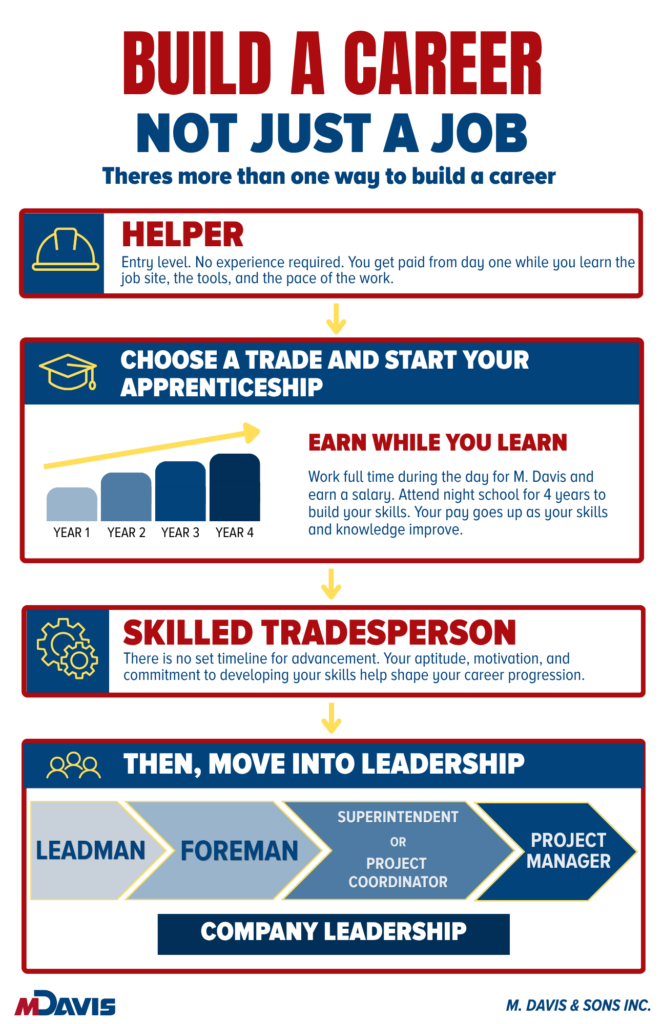
Employees can also earn while they learn, furthering their education without sacrificing pay. M. Davis strongly encourages every tradesperson to enroll in the program and offers assistance to help fund school fees for team members willing and able to grow their skills.
Misconception: Construction Jobs Don’t Pay Well
There is a common perception that blue-collar work comes with a lower paycheck, but a career in the skilled trades can offer competitive earnings, and income can increase as workers gain experience and take on greater responsibilities.
NCCER’s career pathway analysis found:
- A median annual journeyman salary of $63,456
- A median starting salary of $47,000 for four-year college degree holders in its comparison
While pay varies by trade, experience, and location, the comparison challenges the idea that choosing a career in construction automatically means earning less.
Misconception: There Is Little Room for Growth in Construction
A career in construction can evolve over time. As employees gain experience and take on new responsibilities, they can move into leadership roles or pursue opportunities in different areas of the industry.
At M. Davis, employees are encouraged to keep developing their knowledge and furthering their education as they work toward their professional goals.
Career progression does not look the same for everyone. It may mean:
- Becoming an expert in a trade
- Moving into project management
- Stepping into leadership
- Moving to another area of the company
A career in construction can continue to develop well beyond the first job.
Why Careers in Construction Month Matters
The construction industry needs more people entering the workforce. According to Associated Builders and Contractors, the industry will need an estimated 349,000 net new workers in 2026 to meet demand, followed by another 456,000 in 2027.
That makes it important to give students, young professionals, and others interested in the industry a clearer picture of what construction has to offer. For some, that may mean a skilled trade, and for others, it may mean another role behind the work. Careers in Construction Month is a chance to challenge outdated ideas about the industry and help more people see construction as a career worth considering.